Last week at the Business School faculty meeting, Mike was given two awards - one for Best Teacher of winter term, and one for Most Inspirational, a student-nominated prize. He got both last year, too, and the Dean apparently looked at him funny and murmured something about needing to do some monopoly-busting or some such. The only way that they can do that - and it has happened, three different times - is to rewrite the rules of qualification so as to exclude previous winners of x or more awards. Which seems a tad tainted, if one asks me, but no one did.
Here's to Mike, Best and Most Inspirational Teacher! You rock, love.
Friday, June 3, 2011

Wednesday, June 1, 2011
The Birds!
This is, apparently, the year of the birds. We must have dozens of goldfinches, and the house finches, purple finches, and two kinds of grossbeaks (evening and black-headed) are also very plentiful. There is one male goldfinch who has no yellow to him- he's white with black markings instead. I call him Whitey. Not too original, but he ignores us no matter what I call him.
One day a couple of weeks back, Mike commented that he had only seen the Western Tanager once in all the time we've lived here. The very next day, he saw a male twice!
While I'm writing, there was a starling hanging out in the garden. We have over half a dozen tree swallow birdhouses under the eaves of the barn, just above the garden beds. The swallows seemed pretty provoked by the starling's presence, and dive-bombed him until he gave up and flew off.
The swallows also nest in the purported bluebird houses, and usually manage to pre-empt any western bluebirds. However, this year a nesting pair of blues have held out against the swallow bullies and are out, feeding and adding their unmistakable color to our world. They are the legendary Bluebirds of Happiness, and they live right here.
As every year, we have two varieties of humming birds. They arrive pretty early, so I'm glad when we have viburnum and early rosemary in bloom to get them through until the big bloomers make the scene.
We've seen great blue herons, Canada geese, mallards and merganser ducks down on the creek lately. All seem to be nesting.
I've seen a red-tailed hawk drop on prey just in the front pasture twice in the past week and a week ago I was out throwing the blue rubber ball for Charlie when a bald eagle flew over the far end of the back yard.
My best and worst story, though, is that the next day when I was out throwing the ball with the ball launcher, the ball arced out and hit a tree swallow, dead-on, mid-air! About 15-20 feet up. The bird was badly stunned and only managed to flap feebly - enough to keep from crashing to the ground - a kind of slow spiral down. Then it lay there, twitching, on its back. I picked it up and wondered where I could put it safely to keep it sheltered and out of the way of the cat. I put it up on the fiberglass roof of our compost pile where it sat, bewildered, until it suddenly flew off. No weird maneuvers, seemed OK.
My hope is that the incident will create buzz among the swallows about a really big, fast, and belligerent bluebird and that the blues will gain some street status.
One day a couple of weeks back, Mike commented that he had only seen the Western Tanager once in all the time we've lived here. The very next day, he saw a male twice!
 |
| Yes, there he is! Right outside the dining room door. A tad fuzzy on focus, but decidedly a western tanager. Handsome dude, eh? Mike took the photos. |
 | |
| Just for a fuller effect. |
The swallows also nest in the purported bluebird houses, and usually manage to pre-empt any western bluebirds. However, this year a nesting pair of blues have held out against the swallow bullies and are out, feeding and adding their unmistakable color to our world. They are the legendary Bluebirds of Happiness, and they live right here.
As every year, we have two varieties of humming birds. They arrive pretty early, so I'm glad when we have viburnum and early rosemary in bloom to get them through until the big bloomers make the scene.
We've seen great blue herons, Canada geese, mallards and merganser ducks down on the creek lately. All seem to be nesting.
I've seen a red-tailed hawk drop on prey just in the front pasture twice in the past week and a week ago I was out throwing the blue rubber ball for Charlie when a bald eagle flew over the far end of the back yard.
My best and worst story, though, is that the next day when I was out throwing the ball with the ball launcher, the ball arced out and hit a tree swallow, dead-on, mid-air! About 15-20 feet up. The bird was badly stunned and only managed to flap feebly - enough to keep from crashing to the ground - a kind of slow spiral down. Then it lay there, twitching, on its back. I picked it up and wondered where I could put it safely to keep it sheltered and out of the way of the cat. I put it up on the fiberglass roof of our compost pile where it sat, bewildered, until it suddenly flew off. No weird maneuvers, seemed OK.
My hope is that the incident will create buzz among the swallows about a really big, fast, and belligerent bluebird and that the blues will gain some street status.
This Blog's for you, Bud!
After a several month hiatus, I am resuming this blog. I sent an e-mail to my dad, Bud Hoffer, and tried to attach a photo easily from my computer's library and it simply didn't work. Dad likes to have a printed page to be able to read, and loves seeing the photos we collect. So, here goes, Dad, this one's for you!
Every summer, we have a project that commandeers Mike's time. Last year, he spent most of the summer preparing for teaching in Italy, especially for the Consumer Behavior course - one that he never teaches at the U of O. But, here and there, he also found time to complete the guest cottage sufficiently for our summer guests.
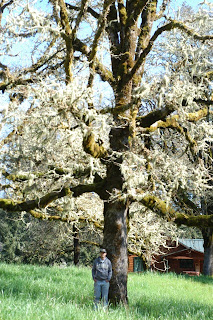 Mike stands below the site of our next project: the tree house! This lovely oak is behind the main house, and is one of several old giants back there. We intend to build a platform on which the tree house will be constructed this summer. It will connect to another oak via a rope bridge that an engineer (!! someone we know!!) is designing. There is noise about a possible fire pole and a zip-line. If only it stood over the swimming hole.....
Every summer, we have a project that commandeers Mike's time. Last year, he spent most of the summer preparing for teaching in Italy, especially for the Consumer Behavior course - one that he never teaches at the U of O. But, here and there, he also found time to complete the guest cottage sufficiently for our summer guests.
 |
| The outside of the guest house, fairly complete. |
 | |
| An interior shot, showing beams, fancy wood working touches, and salvaged stained glass window. |

Saturday, December 4, 2010
Time to leave Italia
 |
| Snow adorns the Alpina cafe in Paderno, two weeks ago, and again today! |
Well, dear friends, our time here in Paderno del Grappa is coming to an end rather rapidly. Last night we had the final dinner out with faculty at the same Casa Bianca where we ate our Thanksgiving meal, and the folks there knocked themselves out on our behalf. Excellent food, and excellent vegetarian and gluten-free selections as well. Everyone was enjoying each others' company and the volume of conversation was near deafening, until the dessert came - a home-made vanilla gelato with a warm berry sauce - and the room fell quiet. Except for spoon scraping bowl.
We have been blessed with an exceptional group of people with whom to work and live while here. The faculty are all dedicated and hard-working, and enjoy the kids, the environment, the program, and the travel opportunities. They are positive, kind, bright, funny and thoroughly delightful to spend time with. It has been a joy to be among such folk and it will be difficult to part from them. I hope we have made some friends with whom we will maintain contact, and even reunite. Maybe even here!
Last time we left here we said to each other, "That was great, but we don't need to do it again. Been there, and done that." Now we leave and hope to return.
I have grown even more impressed with and fond of this region of Italy. It is beautiful, quiet, authentic, rural, rich in history, and very Italian. It is also very conservative, socially, and resists change. There are changes looming all over Europe, and the entrenched populace is alert to and averse to them.
Immigration is one such perceived 'threat' - where last time there were very few noticeable immigrants, now there are many more. From India, Africa, Asia, and the Middle East. Where former immigrants were interested in and willing to be involved in assimilation, new arrivals seem more likely to cling to their former cultures. This is seen as eroding the Italian lifestyle.
The culture here is integrally linked to agriculture, with small fields of every imaginable crop grown in any available location, vineyards, olive orchards, and hayfields between the rural lanes. Everyone keeps some level of kitchen garden and most homes grow a variety of fruit trees, herbs and veggies. Sheep are herded through the lanes to graze down the fields, manure spreaders trundle along the main roads, and flocks of cows descending from the mountain pastures block traffic on their return every autumn. The pastoral effect is cultural and part of what the way of life is here.
 |
| This is Gabriella's Ortofrutta, a local truck-farm produce outlet. Most of the produce is from Italy, much from this region. We got most of our fruits and veggies here, as it was the very best, always primo fresh. That's what happens when it grows 5 kilometers away. |
 |
| A corner of the CIMBA campus, a La Salle order Catholic private school, during warmer weather earlier in our stay. |
Another change in the offing is dealing with trash disposal. Italians love cleanliness, and they love packaging, and there is a lot of trash generated in the process of living. This province, the Veneto, is exceptional within Italy in that it has gotten on board with a comprehensive recycling program, has educated the populace, and has provided excellent almost daily service for the various recyclables. There are other regions in the south that are struggling with trash issues - Naples has a grant from the EU to try to get its trash system under control and out from the grip of the Mafia. Campania is a region that took on other areas' junk, and now finds that close to 50% of the soil is contaminated. Much Italian garbage is sent to Africa for disposal, and surely there are problems that will develop with that system. Obviously, this is an issue much larger than Italy alone, and it stands as a case in point of how the personal has become global.
 |
| A home that we walk past every time we come into the campus, flanked by the base of Monte Grappa. |
That's all from Italy! We fly out on Sunday am to London, then go to Chicago to see Dad Hoffer for three days. From there we head home on Dec 9th. Home!
Monday, November 29, 2010
Prague
We had heard that Prague is a great place to visit for quite a while. When we lived in Italy in 2006, Mike's dad, Hank, spent several days there before coming to see us. Several other friends have been there since then and we kept getting great reports. It was time to see for ourselves.
We took the train from Budapest to Prague, going through northern Hungary and western Slovakia. The scenery evolved as we progressed - northern Hungary looked less bleak than we thought it might, but retained much of Budapest's grey tones. Western Slovakia was picturesquely rural and agricultural - apparently quite the breadbasket of Eastern Europe. Eastern Czech Republic showed more color and order and wealth, and Prague exhibited its vitality from its outskirts in.
"Vital" is the word that we found ourselves returning to again and again. This is no small feat for an ancient city striving to maintain its heritage identity while creating a modern niche in terms of trade, education, mass transit, and new markets. Tourists come for the history, architecture, the sights, the tours, and the entertainment, but if the city lacks vitality, there is little reason to consider returning. "Been there, done that," doesn't apply if the destination continues to evolve and attract. Prague does.
By a fortuitous quirk of hotel overbooking, we ended up removed from the tourist-heavy Old City, but close enough to access it easily by the city buses and foot. In our daily trek through the newer areas, Wenseslas Square, and the Old City, we got to experience various facets of the city, and our hotel was fabulously quiet, unlike those close to the Old hub. Not to mention that we were within a block or two of three vegetarian restaurants and a great little natural foods store. (More on this later: the VRI to city vitality.)
So, what's to like about Prague besides the wealth of vegetarian amenities? The Old Town, intact in spite of two world wars, and brimming with beautifully built and maintained architectural treasures;
Home of Franz Kafka. Prague was his birthplace, and is duly proud of the distinction.
Prague is the home of a Jewish quarter. There are several old synagogues and an impressive cemetery. The cemetery contains over 17000 tombstones, all on less than one acre. Though Prague took in a wandering group of dispossessed Jews when few other communities would consider it early in its history, the resident Jews were not allowed much land and even less for the purpose of burial. We went into a synagogue which is now dedicated to the inscription of the names of those Jews killed in World War II from the Prague area. Each name is written by hand on the walls of the inner chambers. This in itself is powerful, but when I saw surnames of folks I now know: Fink, Schaffer, Schmit, and, yes, Hoffer, it was chillingly personal.
Anyone who has read The Amazing Adventures of Kavalier and Clay will remember the Golem and its connection to Prague and the Jewish Quarter. I refer those who have not, back to the novel - a wonder. The Golem lives on in tourist souvenir booths, where one can now buy little Golems to take home. We didn't.
Perhaps there is a connection from the Golem to puppetry. At any rate, Prague is home to many many marionette shops and a marionette theatre. Almost anyone can end up as a puppet, it appears:
We also saw marionettes of current politicians, celebrities and other cultural targets.
Protestantism and independence, linked not only psychically for the Czechs, but commemorated together in the town square by a statue with the figure of Jan Hus at its focus. Hus was a priest with a mind toward reforming the Catholic Church more than 100 years before Martin Luther came on the scene. His mistake was to take his ideas to Rome, where he was killed. Modern Prague has taken his spirit of reform and independence as its inspiration. We went on a "free tour" led by an ex-pat American, a totally enjoyable time with well-told stories. He verbally depicted the 1989 Czech Revolt at Wenceslas Square, in which over 200,000 Czech citizens gathered peaceably, then took out their keys. Each person jangled their keys, and the combined effect spoke their frustration with their sense of imprisonment relative to the world and their own freedoms.
Prague, home of Alphonse Muncha, became a germinal point for the development of Art Nouveau. There are myriad examples all over the Old Town.


We took the train from Budapest to Prague, going through northern Hungary and western Slovakia. The scenery evolved as we progressed - northern Hungary looked less bleak than we thought it might, but retained much of Budapest's grey tones. Western Slovakia was picturesquely rural and agricultural - apparently quite the breadbasket of Eastern Europe. Eastern Czech Republic showed more color and order and wealth, and Prague exhibited its vitality from its outskirts in.
"Vital" is the word that we found ourselves returning to again and again. This is no small feat for an ancient city striving to maintain its heritage identity while creating a modern niche in terms of trade, education, mass transit, and new markets. Tourists come for the history, architecture, the sights, the tours, and the entertainment, but if the city lacks vitality, there is little reason to consider returning. "Been there, done that," doesn't apply if the destination continues to evolve and attract. Prague does.
By a fortuitous quirk of hotel overbooking, we ended up removed from the tourist-heavy Old City, but close enough to access it easily by the city buses and foot. In our daily trek through the newer areas, Wenseslas Square, and the Old City, we got to experience various facets of the city, and our hotel was fabulously quiet, unlike those close to the Old hub. Not to mention that we were within a block or two of three vegetarian restaurants and a great little natural foods store. (More on this later: the VRI to city vitality.)
So, what's to like about Prague besides the wealth of vegetarian amenities? The Old Town, intact in spite of two world wars, and brimming with beautifully built and maintained architectural treasures;
 |
The Charles Bridge - along with Charles Square and Charles University - was named after King Charles, a regent who actually may have deserved the tributes. The Bridge, seen here from the center toward the Castle side of town, is dotted with various statues all along its length, serves as a public market and gathering place, and is home to several buskers and groups of buskers. |
 |
| View with statues, the Prague Castle, and the Vlatava River. |
 |
| Atypical busker. |
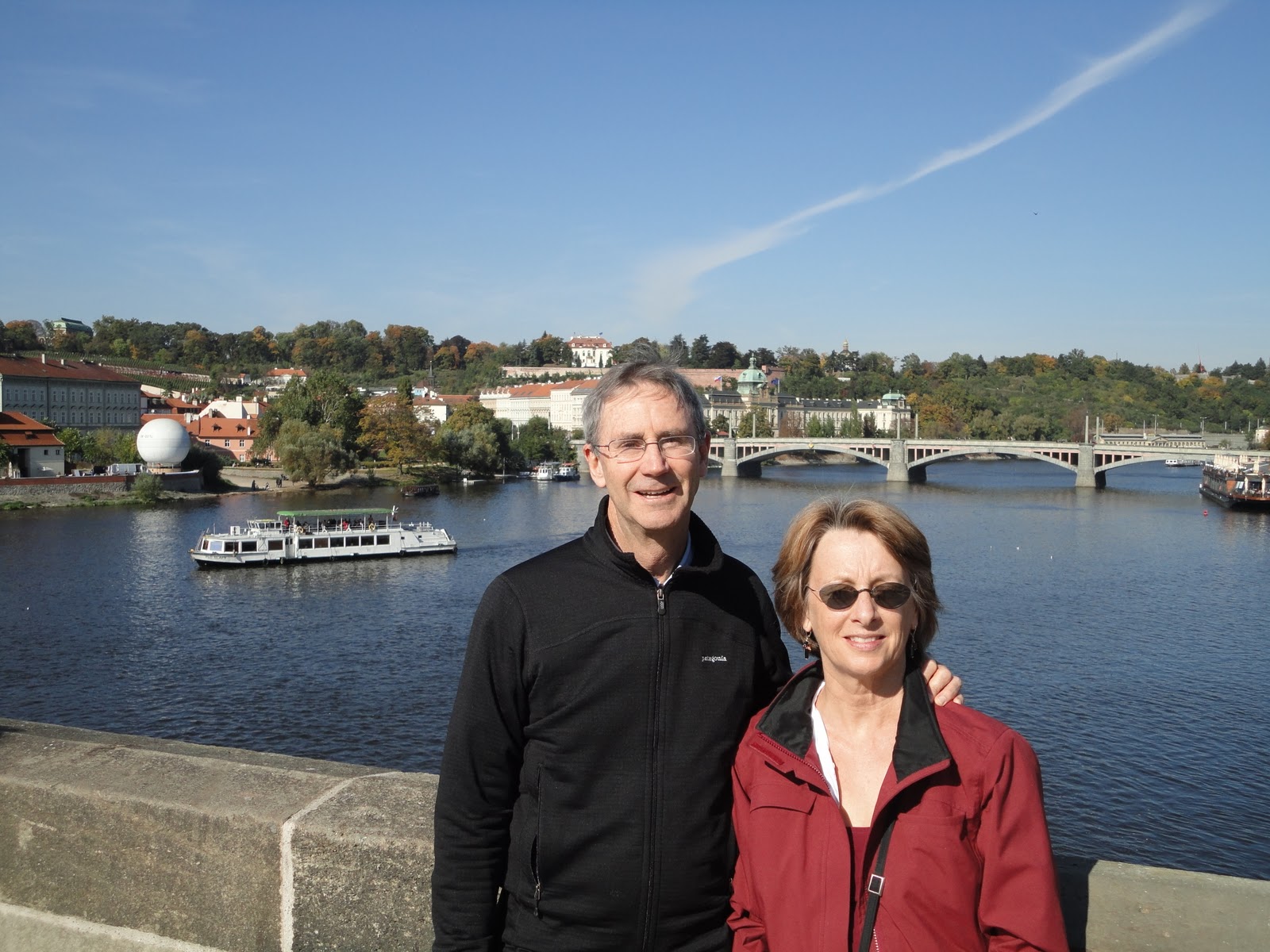 |
| Typical tourists. |
 |
| Typical buskers. |
 |
| The Prague Castle, within which is the St Vitus Cathedral. The castle continues to be the seat of the Czech government, and is the world's largest functioning castle. |
 |
| Interior of St Vitus Cathedral. |
 |
| There is a tower within the cathedral that is open - for a fee - to folks who want to climb to the top. Personally, I have never liked heights. Mike talked me into it. I'm glad he did. |
 |
| View of interior of Prague Castle yards, the west bank of the Old City, the Vlatava River and its bridges. The views were amazing. |
 |
| The cathedral roof and another tower. This church is the most heavily gargoyled structure I have ever seen: |
 |
| Look closely at the gargoyle outspouts across the top. If you have a computer with decent resolution, you can see that they look a lot like little pigs with crowns and wings. When pigs fly! I only wish I could have gotten a closer shot, but that would have entailed flight or mountaineering gear, or a fancier camera. |
 |
| Back in the center of the Old Town, in Charles Square, one finds this fabulous Astronomical Clock on the City Hall. People flock there to watch the hours struck, as the figures you see all move and a rooster crows, and other mechanical marvels unfold. It is beautiful, and keeps the hour, the day, the month, the season and the year. |
Home of Franz Kafka. Prague was his birthplace, and is duly proud of the distinction.
 |
| Prague's civic tribute to Kafka. There is also the Kafka Museum, but what would that contain? Giant cockroaches? "The Existential Room"? |
Prague is the home of a Jewish quarter. There are several old synagogues and an impressive cemetery. The cemetery contains over 17000 tombstones, all on less than one acre. Though Prague took in a wandering group of dispossessed Jews when few other communities would consider it early in its history, the resident Jews were not allowed much land and even less for the purpose of burial. We went into a synagogue which is now dedicated to the inscription of the names of those Jews killed in World War II from the Prague area. Each name is written by hand on the walls of the inner chambers. This in itself is powerful, but when I saw surnames of folks I now know: Fink, Schaffer, Schmit, and, yes, Hoffer, it was chillingly personal.
Anyone who has read The Amazing Adventures of Kavalier and Clay will remember the Golem and its connection to Prague and the Jewish Quarter. I refer those who have not, back to the novel - a wonder. The Golem lives on in tourist souvenir booths, where one can now buy little Golems to take home. We didn't.
Perhaps there is a connection from the Golem to puppetry. At any rate, Prague is home to many many marionette shops and a marionette theatre. Almost anyone can end up as a puppet, it appears:
 |
| Pirate puppets. |
 |
| Royal marionettes, court figures and jesters. |
 |
| Witches! |
Protestantism and independence, linked not only psychically for the Czechs, but commemorated together in the town square by a statue with the figure of Jan Hus at its focus. Hus was a priest with a mind toward reforming the Catholic Church more than 100 years before Martin Luther came on the scene. His mistake was to take his ideas to Rome, where he was killed. Modern Prague has taken his spirit of reform and independence as its inspiration. We went on a "free tour" led by an ex-pat American, a totally enjoyable time with well-told stories. He verbally depicted the 1989 Czech Revolt at Wenceslas Square, in which over 200,000 Czech citizens gathered peaceably, then took out their keys. Each person jangled their keys, and the combined effect spoke their frustration with their sense of imprisonment relative to the world and their own freedoms.
 |
| Jan Hus to the left, with the oppressed of Prague to the right. |


Classical music: Every church in Prague seems to host some variety of musical concert almost every night. There were a whole lot of organ music concerts of Vivaldi’s Four Seasons, Pachelbel’s Canon in D, and other standard fare. It became a challenge to find a concert without that kind of boilerplate repertoire. We ended up going to a chamber music concert at the Music Academy because we wanted to avoid an organ concert, and because it promised to cover some Dvorak. Lo and behold, they also did the perfunctory – and their hearts truly were not in it – “Spring” from Vivaldi’s 4S, and P’s C in D. But the Dvorak was lovely, the musicians obviously cared more about it (I watched bowing technique as a visual cue, and it proved very indicative), and it was a lovely evening in a beautiful concert hall.
 |
| The Academy string quintet. Note the imposing organ looming in the background. If we had a taste for organ music, this city would have been a goldmine. |
Finally, this note: In Prague, the Vegetarian Restaurant Index to a City's Vitality was cemented. We had noted this as a possibility in London, where the most VRs were in the most avant-garde section of town, and decided that it has credibility while here. It's a simple premise: those cities with more vegetarian restaurants are the most vital. Witness Portland and Eugene, Oregon. The link is young people. See, when you have a city that is attractive to young people, you have a city that is more vital and you have more VRs. Simple, obvious.
Saturday, November 27, 2010
The talent show
Faithful readers may recall that in the wake of Mike's guitar purchase, the subsequent students' guitar purchases, and the discovery of several talented individuals, a talent show came into plan. Well, it happened a few days back, and now we have a couple of photos to share, thanks to Sandy Peace (our camera overloaded that night, poor thing). Mike started out as a backup 'singer' for Bob Peace's rap skit:
Then Mike, one set later, came back on stage as the guitar-man for our duet, "Falling," by Kate Rusby. At times I thought the title way too appropriate, but we managed to keep our balance, hit the right notes, end together, and neither fell nor failed. Yay!

Yet another milestone for our Paderno experience is now safely under our belts, and the last week here approaches. There are increasing moments of bittersweet and nostalgia, but we are getting very psyched about being home again. Stay tuned for further postings as we manage them.
 | |
| Lookin' bad in the black hoodie, 'Dore'. The two middle kids are Oregon students who happily enough stepped up to the challenge, thank you Stephan and Ryan. The far left long-hair is professor Terry Robertson, with the skit's star, far right, Bob Peace. We suggested several names for the group, including Peace and Justice (Bob is a lawyer) and Give Peace a Chance. Even in the face of such brilliance, they remained nameless. |

Yet another milestone for our Paderno experience is now safely under our belts, and the last week here approaches. There are increasing moments of bittersweet and nostalgia, but we are getting very psyched about being home again. Stay tuned for further postings as we manage them.
Friday, November 26, 2010
Happy Thanksgiving to you all!
We had a quiet day this Thanksgiving. Slept in, worked out at the gym, spent some time at the office, called family to say HT!.
Then we went out to eat with our friends and neighbors, Bob and Sandy Peace (great name, isn't it?), from North Carolina.We chose a place that Mike and I had been to twice last time we lived here (Bri and Rebecca, we took you there), but not since, "Casa Bianca" (white house, which it is), in Fonte, the village south of Paderno. The proprietress actually seemed to remember us, and fed us some of the best food we've had in Italy this trip.
This morning we woke to rain, which turned to snow! This is a first for us, as there was none of that at all in 2006. Paderno is pretty in the snow:
And now, with thanks to Ron Morey for supplying them, some quotes relevant to this great holiday:
“There are only two ways to live your life. One is as though nothing is a miracle. The other is as though everything is a miracle.” — Albert Einstein
“Can you see the holiness in those things you take for granted–a paved road or a washing machine? If you concentrate on finding what is good in every situation, you will discover that your life will suddenly be filled with gratitude, a feeling that nurtures the soul.” — Rabbi Harold Kushner
“No duty is more urgent than that of returning thanks”. — Unknown“What if you gave someone a gift, and they neglected to thank you for it-would you be likely to give them another? Life is the same way. In order to attract more of the blessings that life has to offer, you must truly appreciate what you already have.” — Ralph Marston
“When we become more fully aware that our success is due in large measure to the loyalty, helpfulness, and encouragement we have received from others, our desire grows to pass on similar gifts. Gratitude spurs us on to prove ourselves worthy of what others have done for us. The spirit of gratitude is a powerful energizer.” — Wilferd A. Peterson
 |
| Molly, Mike, the proprietor's daughter, Elena, Bob and Sandy Peace. That is a fireplace behind us, and there was a lovely fire burning in it. Elena practiced her school English on us. |
This morning we woke to rain, which turned to snow! This is a first for us, as there was none of that at all in 2006. Paderno is pretty in the snow:
 |
| The palm trees outside our apartment window look a little bedraggled with snow on their heads. It was wet, won't last long, but it was kind of fun. |
 |
| Also from our window, the near-by church steeple, mid-snowfall. |
“There are only two ways to live your life. One is as though nothing is a miracle. The other is as though everything is a miracle.” — Albert Einstein
“Can you see the holiness in those things you take for granted–a paved road or a washing machine? If you concentrate on finding what is good in every situation, you will discover that your life will suddenly be filled with gratitude, a feeling that nurtures the soul.” — Rabbi Harold Kushner
“No duty is more urgent than that of returning thanks”. — Unknown“What if you gave someone a gift, and they neglected to thank you for it-would you be likely to give them another? Life is the same way. In order to attract more of the blessings that life has to offer, you must truly appreciate what you already have.” — Ralph Marston
“When we become more fully aware that our success is due in large measure to the loyalty, helpfulness, and encouragement we have received from others, our desire grows to pass on similar gifts. Gratitude spurs us on to prove ourselves worthy of what others have done for us. The spirit of gratitude is a powerful energizer.” — Wilferd A. Peterson
Subscribe to:
Posts (Atom)